CODIS
DNA profiling is a powerful tool used by law enforcement to help solve crimes. The CODIS
Section is responsible for generating DNA profiles for offenders requiring collection in accordance with state
statute. RSMo 650.055 requires the following individuals to provide a DNA sample:
- those who are found guilty of a felony offense or any offense under Chapter 566
- those seventeen or older who are arrested for burglary in the first degree, burglary in the second degree, or a felony offense under chapters 565, 566, 567, 568, or 573
- those determined to be a sexually violent predator
- individuals required to register as a sexual offender
DNA profiles generated from these samples will be entered into the CODIS (COmbined DNA Index System) database. The FBI Laboratory's Combined DNA Index System (CODIS) blends forensic science and computer technology into an effective tool for solving crimes. CODIS enables federal, state, and local crime labs to exchange and compare DNA profiles electronically, thereby linking crimes to each other and to offenders. For more information on CODIS visit the FBI Laboratory's website.
CODIS generates investigative leads for crimes where biological evidence was recovered from the crime scene. DNA profiles from the crime scene samples are searched against profiles in the forensic (crime scene samples), convicted offenders, arrestee, and missing persons indices of CODIS. When two or more cases are matched together, the investigating officers are notified, which helps law enforcement agencies of multiple jurisdictions to coordinate their efforts and share leads. Matches between the forensic index and the offender indices will provide investigators with the possible identity of the perpetrator of a crime. Associations with offenders have been particularly helpful in solving older crimes in which a suspect was never developed. Investigators ultimately decide whether to pursue the lead by obtaining a DNA standard from the individual and submitting it to the DNA casework section for comparison to the original evidence. As more profiles are entered into CODIS, investigators have an increased chance of finding a match between evidence and a possible suspect.
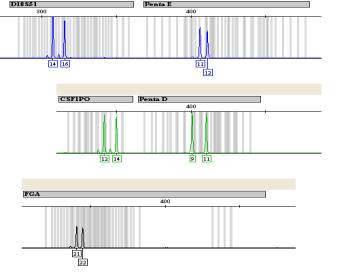
Profile obtained from blood left at scene of an assault.
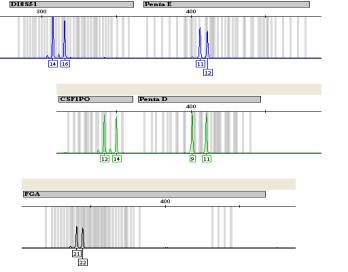
Profile obtained from convicted offender and entered in CODIS. CODIS hit made between assault crime scene sample and convicted offender.
Currently, the Department of Corrections' Division of Adult Institutions (DAI) and Division of Probation and Parole, the Department of Mental Health, and arresting agencies are responsible for identifying who needs to be collected. The Missouri State Highway Patrol provides the sampling supplies to the designated agencies who perform the DNA collection. The sexually violent predators are collected by the Highway Patrol.
CODIS
- Offender DNA Submission (SHP 6)
- DNA Expungent Notification Form (SHP 420)
- MSHP Offender DNA Profiling(SHP 424)
Arrestee DNA Collection Video
For Offender DNA Collection training information:
Training is available on site and via WebEx for one hour of POST credit in Technical Studies.
Missouri State Highway Patrol Crime Laboratory
CODIS Training Flyer: CODIS Training Flyer
MSHPCODIS@mshp.dps.mo.gov